
Video Privacy Protection Act (VPPA) Explained
An explainer on the Supreme Court case testing who counts as a “consumer” under the VPPA, and why video and tracking pixels are driving new lawsuits.
An explainer on the Supreme Court case testing who counts as a “consumer” under the VPPA, and why video and tracking pixels are driving new lawsuits.
A law written in 1988 to protect people's video rental habits is now before the Supreme Court, in a case that could decide how much legal risk ordinary websites face for mixing video with everyday tracking tools.
The U.S. Supreme Court has agreed to hear Salazar v. Paramount Global, a case that will decide who can sue under the Video Privacy Protection Act (VPPA), a federal law most people have never heard of. Federal courts don't agree on the answer, and businesses already facing these lawsuits include far more than streaming services: sports sites, retailers, real estate platforms, and media companies that simply show video and run the same advertising tools most websites use.
The dispute often comes down to something surprisingly ordinary: does signing up for a newsletter or creating an account on a website count, if that same website also happens to show video?
Congress passed the VPPA in 1988, right after a newspaper published Supreme Court nominee Robert Bork's video rental history during his confirmation hearings. Lawmakers wanted to stop video stores from telling anyone else what movies their customers rented. The law says a business that rents, sells, or streams video can't hand over information tying a specific person to the specific videos they watched, unless that person agrees.
The law lets an individual sue a company directly, without needing a regulator to step in first, and if a court finds a violation, it guarantees at least $2,500 per person, even if nobody can prove they were harmed. Courts have since applied the law well beyond physical video stores, extending it to streaming platforms and ordinary websites, which is why a law written for the VHS era is suddenly a modern legal risk.
Most websites run small pieces of tracking code, often called pixels, that report visitor activity back to companies like Meta or Google, usually to measure or target ads. It's extremely common: a March 2024 LOKKER report found about 47% of websites analyzed used Meta's pixel, including 55% of S&P 500 companies and 58% of retail sites.
These lawsuits focus on something more specific: a pixel that, when someone watches a video, sends the name or link of that video together with something that identifies the visitor, like an account ID tied to a browser cookie, back to a company like Meta. Plaintiffs argue that pairing exactly what someone watched with who they are is exactly what this 1988 law was written to protect.
This shows up in a few recurring situations: someone watches a free video on a site where they'd also signed up for a newsletter; someone trades an email and zip code for a feature like show reminders, then watches video on the same platform; or a platform sells video-linked products while several ad tools run at once.
Not every pixel or video creates this kind of legal exposure. It depends on exactly what a tool sends, and on whether the visitor counts as someone the law protects in the first place, which is exactly what's now before the Supreme Court.
The Court agreed on January 26, 2026, to hear Salazar v. Paramount Global, with arguments set for October 14, 2026. Here's the story behind it: Michael Salazar signed up for a free newsletter on 247Sports.com, a Paramount-owned sports recruiting site, giving his email and IP address. He says Paramount's Meta tracking tool later sent his Facebook account information, along with the names and links of videos he watched while logged into Facebook, to Meta without asking him first.
A federal court and a divided panel of appeals judges sided with Paramount: they said signing up for a newsletter doesn't make someone a video consumer under the law, so it didn't apply.
That put this court at odds with two others that looked at nearly identical situations and reached the opposite conclusion:
A different fan who'd signed up for the NBA's free newsletter and watched free video on NBA.com while logged into Facebook made the same complaint about the same tracking tool. That court said the law protects him too, since he'd signed up for something from the company, even if it wasn't video-related.
Viewers of a classic-TV website had traded their email and zip code for show reminders. That court agreed the law covered them, reasoning that people can pay for a service with their personal information just as easily as with money.
The court deciding Salazar's case disagreed with both, ruling that the law protects only people who signed up for something tied to video, not just any newsletter on a site that also shows clips.
The case has also drawn plenty of outside attention: Meta, the National Retail Federation, the Motion Picture Association, the U.S. Chamber of Commerce, the News/Media Alliance, and America's Newspapers have all filed briefs asking the Court to rule the way Paramount wants, while a privacy group, the Electronic Privacy Information Center, has filed on Salazar's side.
That lineup shows how many mainstream industries, not just tech companies, are watching this closely.
The justices are deciding only who's allowed to bring one of these lawsuits, not whether any specific tracking tool or video setup is against the law.
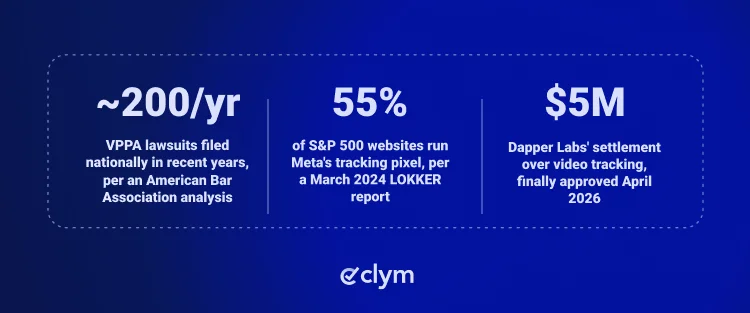
The clearest example of the financial stakes is a case against Dapper Labs, the company behind blockchain-based collectible platforms like NBA Top Shot and NFL All Day. People who'd used those platforms said tracking tools on the sites sent their video-watching and purchase activity to advertising companies without asking first.
The $5 million settlement covers anyone with an active account on those platforms between June 2020 and January 2025. A New York court gave it final approval in April 2026, and payments went out to eligible people in July. Dapper Labs never admitted to breaking the law, and the settlement doesn't say it did; it resolved the case rather than proving that tracking video actually violated the law.
These lawsuits aren't limited to companies that think of themselves as video businesses. Recent cases have reached sports leagues and betting sites, sports news sites, classic-TV streaming platforms, real estate listing sites, and consumer brands whose newsletters and on-site video drew similar complaints, though not every case has held up; one lawsuit against a cereal maker was thrown out because the plaintiff couldn't show the company shared anything specific enough to identify them. The common thread isn't industry or size. It's simply having video content and outside tracking tools running on the same pages, plus, for now, whether a visitor's other interactions with the site count them as someone the law protects.
No. The Supreme Court hasn't ruled yet, and won't even hear arguments until October 2026, with a decision typically expected sometime before its term ends the following summer. The ruling will settle who can sue, not whether any individual company's tracking setup breaks the law. If the justices side with the broader reading, businesses whose only real connection to their video content is a newsletter or account signup elsewhere on the site would stay exposed to these lawsuits. If they side with the narrower reading, that exposure would shrink in the parts of the country currently following it, though little would change for businesses already in places that read the law broadly, or for actual streaming companies.
Find out which outside tracking tools or tags run on any page with video.
Confirm what those tools actually send when someone watches a video, including titles, links, or account identifiers.
Check whether a visitor's cookie or privacy choice actually turns those tools off, not just what a banner on the page claims.
Note anywhere else your site collects personal information, like a newsletter or account signup, since that's the exact connection the Supreme Court is examining.
Review agreements with any outside vendor whose code runs on pages with video.
No. Courts have applied this law to any company that shows video content on its website, not just dedicated streaming services. The Supreme Court is now deciding whether a specific visitor counts as someone the law protects.
Possibly, if your site shows video and a tracking tool sends what someone watched along with something that identifies them, and if that visitor counts as someone the law protects, a question courts currently answer differently depending on where you are.
No. A lawsuit still has to show the tool actually sent information tying a specific person to specific video content, and that the visitor is someone the law protects. Both of those are argued case by case.
The justices will hear arguments on October 14, 2026. The Court doesn't set a decision date in advance, but it usually rules on cases argued early in a term before the term ends the following summer.
Start by finding out which outside tracking tools run on pages with video, and what information they send when a video plays. Clym's free Scanner can show what's currently running on your website.

Mircea is the Chief Operating Officer at Clym, where he leads operations and product strategy to help businesses navigate global data privacy, web accessibility, and transparency and accountability requirements. With a background spanning information security, technology, compliance, and business development, Mircea plays a key role in shaping Clym’s vision and guiding its expansion into new markets. When he’s not coordinating teams or refining product workflows, he is either walking somewhere, reading, sailing or learning about the latest tech innovations.