
GDPR CCPA global privacy compliance
Businesses manage GDPR, CCPA, and global privacy regulations using consent management software that detects location and applies the correct rules automatically.
Businesses manage GDPR, CCPA, and global privacy regulations using consent management software that detects location and applies the correct rules automatically.
172 countries now have some form of data privacy legislation in place, covering 79% of the global population. For businesses with a website that people visit from multiple countries, that means navigating a growing web of overlapping and sometimes conflicting rules, with real financial consequences. GDPR alone has generated over €6.1 billion in cumulative fines since 2018.
A visitor from Germany lands on your website. Thirty seconds later, someone from California does the same. Each one triggers different legal requirements: different consent models, different opt-out rights, different response windows for data requests, and different definitions of what counts as personal data.
Managing this manually does not scale. The businesses that do this well are not running separate compliance programmes for each jurisdiction. They use a unified approach backed by the right privacy compliance software.
This guide breaks down exactly how that works, what the strategy looks like in practice, and what to look for in a tool built to manage multiple regulations from one place.
The challenge is not simply knowing what each regulation requires. It is implementing those requirements at the exact point where users interact with your website, consistently, for every user, from every location, every time.
GDPR and CCPA are the two most discussed regulations, but they are far from the only ones your website may need to account for. The UK GDPR, Brazil’s LGPD, Canada’s PIPEDA, Australia’s Privacy Act, and a growing list of US state privacy laws, including Virginia’s VCDPA, Colorado’s CPA, Texas’s TDPSA, and Florida’s FDBR, all carry their own requirements.
The specific differences matter. GDPR requires opt-in consent for most data processing. CCPA operates on an opt-out model. GDPR imposes a 72-hour breach notification window. CCPA allows up to 45 days to respond to a data subject request, while GDPR requires a response within 30 days.
Colorado has its own distinct requirements, including mandatory opt-in for sensitive data and UOOM signals since July 2024.
These are not details you can handle with a single static cookie banner or a one-size-fits-all policy. The businesses that manage this well start with the right foundation.
Rather than building a separate compliance programme for each regulation, most privacy professionals take a harmonization approach: align with the strictest standard, then make targeted adjustments for local requirements.
GDPR is almost always that strictest standard. It requires affirmative opt-in consent, strict data minimisation principles, robust rights for data subjects, and documented accountability throughout your data processing activities. If your website is structured for GDPR, you are already covering the majority of what CCPA and most other global regulations require.
Privacy experts generally estimate that around 80-90% of GDPR controls also satisfy CCPA requirements. The remaining 10-20% involves adjusting specific elements: switching from an opt-in to an opt-out consent model for California visitors, adding a Do Not Sell or Share My Personal Information link, and configuring different workflows for data subject requests.
This is exactly what modern consent management platforms are built to handle automatically. Rather than manually maintaining parallel compliance setups for each jurisdiction, you configure the platform once and let it apply the correct rules to each visitor based on their location.
The practical work of multi-regulation compliance falls into four areas. Each one needs to be operational, documented, and consistent.
Consent management is the process of collecting, recording, and managing a user's choices about how their personal data is collected and processed. A consent management platform (CMP) is software that automates this process by detecting each visitor's location and serving the correct consent experience for their jurisdiction.
A visitor from Germany should see an opt-in banner that holds all non-essential cookies until consent is given. A visitor from California should see an opt-out experience that allows cookies by default but gives them the right to object to the sale or sharing of their personal information. A visitor from the UK should see the same model as the EU under UK GDPR.
Getting this right requires automatic location detection and a CMP that can serve the correct consent model in real time, without you having to manually configure separate banners for each country.
Clym's consent management platform detects each visitor's regulatory jurisdiction and presents the appropriate banner, consent type, and opt-in or opt-out model automatically. It covers 190+ global regulations from a single integration, including GDPR, CCPA/CPRA, IAB TCF 2.2, and Google Consent Mode v2.
Under both GDPR and CCPA, individuals have the right to request access to, deletion of, and in some cases correction of their personal data. These are called data subject requests (DSRs), and managing them correctly is a core compliance obligation.
The timelines differ: GDPR requires a response within 30 days, extendable to three months in complex cases. CCPA gives businesses 45 days, with a possible 45-day extension. The most practical approach is to default to the stricter GDPR timeline for all requests regardless of where the person is located. This reduces complexity and creates a consistent process.
A centralised DSR portal that routes requests to the right team, tracks deadlines, and maintains a documented audit trail makes this manageable at scale. Clym's platform includes a built-in DSR management workflow so intake, routing, and response tracking are handled from one dashboard.
Global Privacy Control (GPC) is a browser-level signal that communicates a user's preference to opt out of the sale or sharing of their personal information. Under CCPA as amended by CPRA, businesses operating in California are required to recognise and honour this signal.
A growing number of browsers and browser extensions now send the GPC signal by default for users who have opted in. If your website does not recognise and act on the signal, you are not meeting your obligations under California law.
Supporting GPC requires your consent management layer to detect the signal and suppress relevant tracking and data sharing activity accordingly. Clym includes native GPC support, so this is handled automatically without custom development work.
Regulations do not just require you to manage consent and data requests. They require you to document your data processing activities, maintain privacy policies that accurately describe how you handle personal data, and in many cases demonstrate your compliance posture to regulators or auditors.
Privacy policies need to reflect the regulations applicable to your users. A single generic policy may not satisfy both GDPR and CCPA disclosure requirements. GDPR requires specific information about legal bases for processing. CCPA requires specific disclosures about categories of data collected and sold.
Keeping policies accurate and legally current across jurisdictions is one of the more time-consuming aspects of regulatory compliance management. Clym's platform can generate and maintain policies that reflect your specific regulatory profile, reducing legal review cycles significantly.
Understanding the specific differences between GDPR and CCPA helps you identify where a unified approach needs adjustment. The table below covers the areas most relevant to your website's compliance setup.
Requirement | GDPR | CCPA / CPRA |
|---|---|---|
Consent model | Opt-in required for most non-essential data processing | Opt-out model; right to object to sale or sharing of personal information |
Who it applies to | Any business that processes data of EU/EEA residents | Businesses meeting California revenue or data thresholds |
DSR response deadline | 30 days (extendable to 3 months for complex cases) | 45 days (extendable by a further 45 days) |
Breach notification | 72 hours to the supervisory authority | As soon as reasonably possible to affected individuals |
Right to deletion | Yes | Yes |
GPC signal required | No | Yes, under CPRA |
Data sale opt-out right | No direct equivalent | Central to the regulation |
Maximum fine | 20M EUR or 4% of global annual revenue | Up to $7,500 per intentional violation |
Enforcement authority | National data protection authorities (DPAs) | California Privacy Protection Agency (CPPA) |
If you are evaluating privacy compliance software to manage GDPR, CCPA, and other global regulations from a single tool, these are the capabilities that matter most.
Location-based consent detection. The platform should automatically identify where a visitor is located and serve the correct consent model for that jurisdiction. You should not be configuring this manually for every country.
Support for multiple consent frameworks. GDPR, CCPA/CPRA, IAB TCF 2.2, Google Consent Mode v2, and emerging US state laws should all be handled natively. Check what regulations the platform actually supports in practice, not just what it claims to be compatible with.
Built-in DSR management. A way to receive, track, and respond to data subject requests that maintains a documented audit trail. This should be integrated with your consent records rather than sitting in a separate system.
GPC signal support. Native detection and handling of the Global Privacy Control signal, with automatic suppression of relevant data processing when the signal is present.
Policy generation. The ability to generate or maintain privacy policies that reflect the specific regulations applicable to your users, keeping them accurate as the regulatory landscape changes.
Accessibility compliance. An increasing number of regulations include accessibility requirements alongside privacy. A platform that handles both from a single integration reduces implementation overhead significantly.
Audit trail and reporting. Documented consent records, request logs, and exportable compliance reports that can be shared with regulators, legal counsel, or auditors when needed.
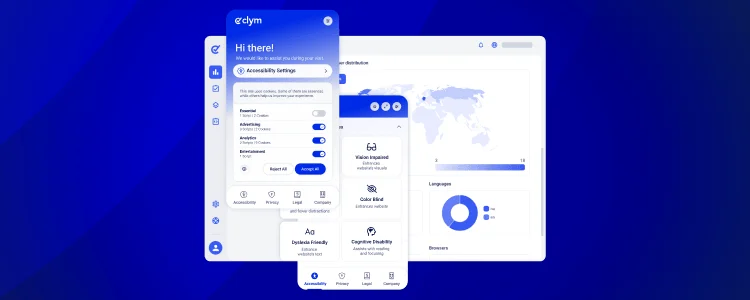
Clym is a consent management and privacy compliance platform built to support GDPR, CCPA, and 190+ other global regulations from a single integration.
When a visitor lands on your website, Clym detects their location and serves the correct consent experience for their jurisdiction automatically. An EU visitor sees a GDPR-compliant opt-in banner. A California visitor sees a CCPA-compliant opt-out experience with native GPC support. A UK visitor sees UK GDPR-aligned consent. This happens without parallel compliance setups or manual configuration for each country.
The platform also includes built-in DSR management, privacy policy generation, and web accessibility compliance tools. These are the core components of a multi-regulation compliance programme, handled from one dashboard. At $49 per month, Clym is designed for businesses that need broad regulatory coverage without the cost or complexity of enterprise-grade tools.
Clym integrates with WordPress, Shopify, custom web applications, and mobile websites through a single script. You can also explore CCPA compliance solutions specifically if California compliance is your primary concern, or review the best CCPA compliance software options to compare what is available on the market.
Managing GDPR, CCPA, and global privacy regulations simultaneously does not require a different tool for each law or a compliance team for each jurisdiction. It requires a unified approach built on the right foundations: jurisdiction-aware consent management, consistent DSR handling, GPC signal support, and documented governance across your data processing activities.
The businesses that manage this well are not starting from scratch for each new regulation. They are using privacy compliance software that applies the correct rules to the correct user automatically, and maintains the audit trail to demonstrate it.
The regulatory landscape is not going to get simpler. But your approach to managing it does not have to get more complex.
The most effective approach is to align with GDPR as your baseline, since it is generally the stricter standard, and then configure specific adjustments for CCPA. A consent management platform that detects visitor location and applies the correct consent model automatically handles the majority of what both regulations require at the point of user interaction.
GDPR requires opt-in consent for most data processing and applies to businesses that handle data of EU residents. CCPA operates on an opt-out model and applies to businesses meeting specific California thresholds. Key differences include consent model, response timelines for data requests, breach notification windows, and the CCPA requirement to honour Global Privacy Control signals.
No. A consent management platform that supports multiple regulatory frameworks can handle both GDPR and CCPA from a single integration. The platform should automatically detect each visitor's location and serve the appropriate consent experience, without requiring separate configurations or tools for each regulation.
A consent management platform is software that collects, records, and manages user consent for cookies and data processing in line with applicable privacy regulations. For businesses operating across multiple jurisdictions, a CMP automates the process of showing the correct consent experience to each visitor based on location, and maintains a documented record of choices for audit purposes.
Global Privacy Control is a browser-level signal that communicates a user's preference to opt out of the sale or sharing of their personal information. Under California's CPRA, which amended CCPA, businesses must recognise and honour GPC signals. A consent management platform with native GPC support detects the signal automatically and suppresses relevant data processing without requiring custom development work.
This depends on where your users are located, not just where your business is registered. If you receive visitors from the EU or EEA, GDPR applies. If you have California users and meet the CCPA thresholds, CCPA and CPRA apply. Many US states have now enacted their own privacy laws, including Virginia, Colorado, Texas, and Florida. A consent management platform that covers 150+ regulations means you are prepared as the regulatory landscape continues to expand.

Adam is the Head of Digital Marketing at Clym, where he leverages his diverse expertise in marketing to support businesses with their compliance needs and drive awareness about data privacy and web accessibility. As one of the company’s original team members, Adam has been instrumental in shaping its journey from the very beginning. When he’s not diving into marketing strategies, Adam can be found cheering on his favorite sports teams or enjoying fishing.