IAB TCF framework explained
The IAB TCF standardizes advertising consent in Europe. TCF v2.3 became mandatory in February 2026. Here's how it works and what publishers need to do.
The IAB TCF standardizes advertising consent in Europe. TCF v2.3 became mandatory in February 2026. Here's how it works and what publishers need to do.
Digital advertising depends on user consent. But getting that consent, communicating it to dozens of ad tech vendors, and doing it in a way that satisfies GDPR? That is the problem the IAB Transparency and Consent Framework (TCF) was built to solve.
Since it launched in 2018, TCF has become the backbone of consent management in European digital advertising. If you run a website, publish content, or work in ad tech, understanding how it works is no longer optional.
In this guide, we will walk you through what the IAB TCF is, how it works, what each version changed, and what the move to TCF v2.3 means for publishers right now.
The IAB Transparency and Consent Framework (TCF) is a standardized protocol developed by IAB Europe that enables websites and apps to collect, store, and communicate user consent preferences to advertising technology vendors. It defines how consent is recorded, which data processing purposes require consent, and how that information is passed along the digital advertising supply chain.
Introduced in 2018, TCF was created to give the digital advertising industry a consistent, GDPR-aligned way to handle user consent. Before TCF, there was no shared language between publishers and vendors for consent signals. Each partnership required its own consent infrastructure.
Today, TCF is used by thousands of publishers across Europe and beyond. If your site runs programmatic advertising and serves users in the EEA, UK, or Switzerland, TCF is almost certainly part of your consent workflow. Clym's IAB TCF solution supports the current v2.3 standard for publishers managing this transition.
At its core, TCF creates a communication layer between three parties: the user, the publisher, and the vendor.
Here is how the consent flow works in practice:
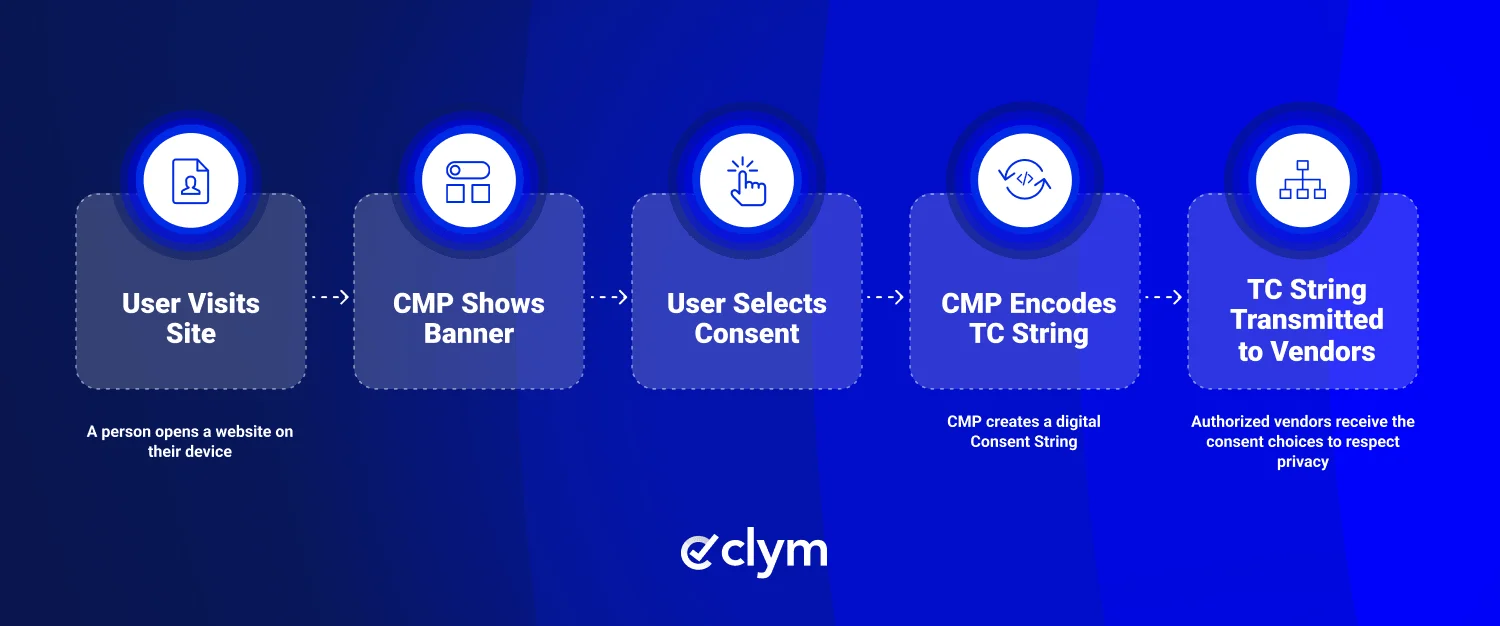
A TC string (Transparency and Consent string) is an encoded record of a user's consent preferences under the IAB TCF. It specifies which data processing purposes the user has consented to, which vendors are permitted to act on those preferences, and whether a vendor was disclosed in the consent interface. TC strings are generated by a certified CMP and stored in the user's browser.
The TC string is accessed by vendors via the TCF JavaScript API embedded on the publisher's page. This is what allows hundreds of ad tech vendors to read a single consent decision rather than each requiring a separate interaction with the user.
TCF defines three distinct roles with specific obligations:
Publishers are operators of websites or apps where the consent interface is presented to users. They are responsible for deploying a certified CMP, displaying accurate information about vendors and purposes, and obtaining valid consent before data processing begins. If you run a website that displays programmatic advertising to users in the EEA, you are a publisher under TCF.
Vendors are advertising technology companies such as DSPs, SSPs, DMPs, and analytics providers that process personal data in connection with a publisher's content. Under TCF, vendors must register with the Global Vendor List, declare the data processing purposes they rely on, and specify the legal bases for each purpose.
CMPs are the technology layer that collects user consent, encodes it into a TC string, and transmits it to vendors. CMPs must be registered and certified with IAB Europe to participate in the framework. Clym's consent management platform is Google-certified and supports TCF v2.3.
TCF defines 10 standard data processing purposes that vendors must declare. Users can grant or withhold consent at the purpose level, not just globally.
Purpose ID | Purpose |
|---|---|
1 | Store and/or access information on a device |
2 | Use limited data to select advertising |
3 | Create profiles for personalised advertising |
4 | Use profiles to select personalised advertising |
5 | Create profiles to personalise content |
6 | Use profiles to select personalised content |
7 | Measure advertising performance |
8 | Measure content performance |
9 | Apply market research to generate audience insights |
10 | Develop and improve services |
Vendors must declare which purposes they rely on, whether they require consent or legitimate interest, and how long they retain associated data. Purposes 3 and 4, which relate to personalised advertising, must now be based on consent rather than legitimate interest as of TCF 2.2.
The Global Vendor List (GVL) is IAB Europe's official registry of advertising technology companies that have registered to participate in TCF. Publishers use the GVL to configure which vendors appear in their consent banner.
If a vendor is not on the GVL, they cannot receive valid TCF consent signals. Publishers should regularly audit their vendor list to ensure all active partners are registered.
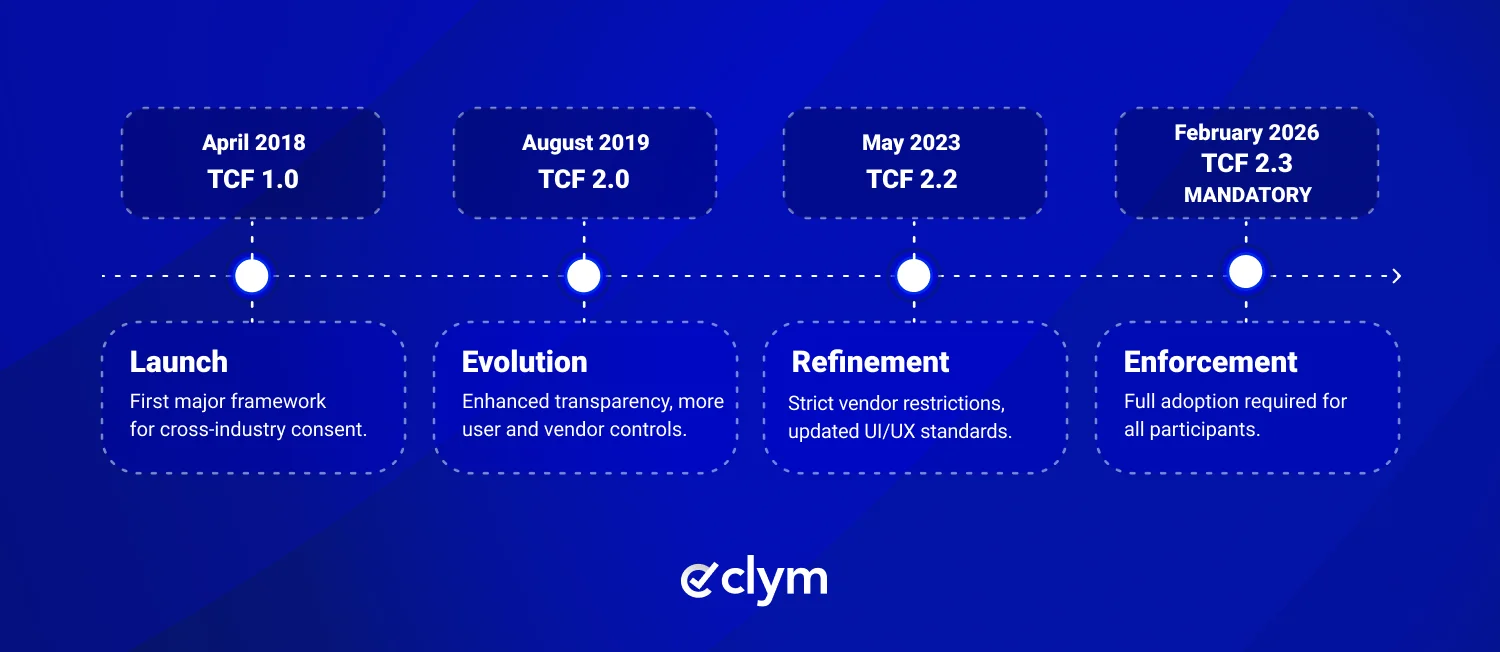
The framework has evolved significantly since 2018. Here is what each version introduced:
Version | Released | Key changes |
|---|---|---|
TCF 1.0 | April 2018 | Original framework. Basic consent collection for GDPR. Limited user controls. |
TCF 2.0 | August 2019 | Legitimate interest added as a legal basis. Publisher controls introduced. Improved vendor transparency. |
TCF 2.2 | May 2023 (effective November 2023) | Legitimate interest removed for targeted advertising. Stronger vendor disclosures. CMP accessibility requirements. Vendor count on initial banner. |
TCF 2.3 | 2025 (mandatory from February 28, 2026) | Mandatory disclosedVendors segment. Provable vendor disclosure in TC string. Required by Google for all newly generated TC strings. |
Released in May 2023 and effective from November 20, 2023, TCF 2.2 brought the most significant user-rights changes in the framework's history.
TCF v2.3 is the current version of the framework. Its most significant change is the introduction of a mandatory disclosedVendors segment in the TC string. For the full migration guide, see our article on the TCF v2.3 deadline for publishers.
The disclosedVendors segment is a required binary indicator embedded in the TC string that confirms whether a specific vendor was actually shown to the user in the CMP interface. This is the core change in TCF v2.3.
Under previous versions, consent signals could be ambiguous. A vendor might appear in a TC string without any evidence that a user was ever shown their details. TCF v2.3 closes that gap. Vendor disclosure is now provable within the technical signal itself.
Google confirmed that all newly generated TC strings must comply with TCF v2.3 from February 28, 2026. Publishers using Google Ad Manager, AdSense, or AdMob who have not migrated to a TCF v2.3-certified CMP risk their ad requests defaulting to Limited Ads.
Limited Ads are served without personalized cookies or full targeting capabilities, which significantly affects programmatic monetization performance.
Feature | TCF 2.2 | TCF 2.3 |
|---|---|---|
Vendor disclosure proof | Not required | Mandatory (disclosedVendors segment) |
Google support post-Feb 2026 | New strings unsupported | Required for new strings |
Revenue risk if not migrated | Low (before 2026) | High if not migrated |
TC string format | Standard | Extended with disclosedVendors |
Note: TCF v2.3 does not require users to re-consent. It is a technical update to how vendor disclosure is signaled in the TC string, not a change to consent collection rules.
TCF does not replace or guarantee alignment with GDPR. It is a technical framework that creates a structured way to collect and communicate consent. The legal obligation sits with the publisher and their vendors.
Under GDPR, processing personal data requires a valid legal basis. For advertising, that typically means either:
GDPR is the law. TCF is the mechanism your business uses to work toward meeting its consent obligations. Having a TCF-compliant CMP is a meaningful step, but it does not replace legal advice or a broader privacy programme. You should also ensure you have a proper cookie policy and privacy policy in place, and that your platform handles data subject requests appropriately.
One important point: GDPR applies to organizations based in the EU or processing data of EU residents. The legitimate interest provisions within TCF are particularly relevant here, as many businesses incorrectly assumed they could rely on legitimate interest for advertising without user consent.
Clym is a Google-certified Consent Management Platform that supports IAB TCF v2.3 with flexible regional configuration. Publishers using Clym can generate TCF v2.3-compliant TC strings, manage vendor disclosures, and configure consent flows by jurisdiction.
Beyond TCF, Clym supports you to manage:
Clym's ReadyCompliance® feature automatically recommends the right consent configuration based on your company profile, making it easier to deploy TCF correctly from the start without manually reviewing each jurisdictional requirement.
The IAB TCF framework exists because digital advertising needs a common language for consent. Without it, every publisher-vendor relationship would require custom consent infrastructure, creating both legal risk and operational complexity.
Since TCF 1.0 in 2018, each version has pushed toward stronger user control and clearer accountability. TCF 2.2 removed legitimate interest for targeted advertising. TCF 2.3 made vendor disclosure provable at the technical level. Both changes reflect a broader shift: consent frameworks are now part of advertising infrastructure, not just a legal formality.
With Google's enforcement deadline now passed, operating without a TCF v2.3-certified CMP carries real risk to ad revenue. Whether you are just starting to implement TCF or managing the v2.3 migration, the right CMP makes the process significantly more manageable.
The IAB Transparency and Consent Framework (TCF) is a standardized protocol developed by IAB Europe that enables websites to collect user consent and communicate it to advertising technology vendors. It helps publishers align with GDPR consent requirements in digital advertising.
No. GDPR is the law governing data protection in the EU. TCF is a technical framework created by IAB Europe to help the advertising industry collect and communicate consent in a GDPR-aligned way. Having a TCF-compliant CMP supports your consent obligations but does not replace legal advice.
A TC string is an encoded record of a user's consent preferences. It is generated by a certified CMP, stored in the user's browser, and read by ad tech vendors via the TCF API. The string specifies which purposes the user consented to and which vendors are permitted to process their data.
TCF v2.3 is the current version. It became mandatory for all newly generated TC strings on February 28, 2026. Publishers using Google Ad Manager, AdSense, or AdMob must use a Google-certified CMP that supports v2.3.
TCF is designed for publishers and vendors operating in the EEA, UK, and Switzerland. If you monetize traffic from users in those regions, TCF likely applies to you regardless of where your business is based. Publishers outside the EU who do not serve EEA users are generally not required to implement TCF.
The Global Vendor List (GVL) is IAB Europe's official registry of advertising technology companies registered to participate in TCF. Publishers use the GVL to configure which vendors appear in their consent banner. Vendors must be registered on the GVL to receive valid TCF consent signals.
Publishers using Google Ad Manager, AdSense, or AdMob without a TCF v2.3-certified CMP risk having their ad requests default to Limited Ads. Limited Ads are served without personalized targeting, which typically reduces programmatic revenue significantly.

Adam is the Head of Digital Marketing at Clym, where he leverages his diverse expertise in marketing to support businesses with their compliance needs and drive awareness about data privacy and web accessibility. As one of the company’s original team members, Adam has been instrumental in shaping its journey from the very beginning. When he’s not diving into marketing strategies, Adam can be found cheering on his favorite sports teams or enjoying fishing.