
The page explains what “global privacy control signal detected” means for marketing, analytics, and website tracking behavior under modern privacy regulations. It also outlines how teams can adapt their workflows using first-party data, contextual targeting, and consent-aware technologies such as CMPs.
What “Global Privacy Control Signal Detected” Means for Marketing and Analytics
The phrase “global privacy control signal detected” is appearing more often across websites preparing for updated U.S. privacy rules. While the signal looks simple, its impact on marketing, analytics, and advertising infrastructure is significant. When a site detects the GPC signal, it must treat the visitor as opted out of selling or sharing personal data, which affects how tracking tools, pixels, ad platforms, and analytics services behave.
To better understand the regulatory context, these two resources offer foundational background:
What is Global Privacy Control (GPC) signal?
Global Privacy Control (GPC) is a standardized privacy preference that automatically communicates a user’s choice not to have their personal information sold or shared. When the signal is received, websites must recognize it as an opt-out request under privacy laws. This requirement is increasingly discussed in the context of GPC signal compliance, where businesses must adjust tracking behavior the moment the signal is detected.
A Consent Management Platform (CMP) plays a central role in this process. Clym, for example, automatically detects incoming GPC signals and applies the correct opt-out behavior without requiring development effort or user interaction.
Unlike legacy signals such as Do Not Track (DNT), GPC is recognized in modern regulatory frameworks, and CMPs are expected to adjust tracking behavior immediately once the signal is detected.
Learn more about Global Privacy Control (GPC), how it works, and what a detected signal means for your marketing and analytics.
What happens when a website detects GPC
Automating the response with RealtimeCompliance™
When a CMP detects the GPC signal, the visitor is placed into an opt-out state instantly. This prevents activities classified as selling or sharing personal information, without the user needing to interact with a banner. Because GPC operates as a CCPA universal opt-out, the visitor’s preference applies immediately across all selling and sharing activities.
Handling these signals manually typically requires complex configuration in Google Tag Manager or custom coding. Clym simplifies this via RealtimeCompliance™, a dynamic engine designed to automatically scan, categorize, and control website services.
Because the system identifies trackers (like Meta Pixel or Hotjar) and their privacy settings in real-time, it instantly suppresses them when a GPC signal is detected, without requiring your team to manually tag scripts or set up exclusion triggers.
Blocking or modifying tracking behavior
Under an opt-out state, third-party scripts may be:
- blocked,
- executed in limited or anonymous mode,
- or prevented from sending identifiers.
This includes tools such as Meta Pixel, Google Analytics, Google Ads tags, LinkedIn Insight Tag, and other marketing or analytics technologies. Some CMPs also integrate with Google Consent Mode v2, allowing platforms like Google Ads and GA4 to use modeled conversions when users opt out of marketing-related data processing.
A CMP helps align script behavior with regional requirements. Clym’s consent management platform evaluates the visitor’s jurisdiction and activates the consent model that fits the relevant regulatory expectations.
Translating GPC for Ad Partners: The Role of IAB GPP
While GPC tells your website to stop selling data, you must also communicate this instruction to your programmatic advertising partners (SSPs, DSPs, and ad exchanges). This is where the IAB Global Privacy Platform (GPP) comes in.
GPP is the standardized framework the ad industry uses to transmit privacy signals across the ecosystem. When a visitor sends a GPC signal:
- Detection: The CMP receives the GPC signal.
- Translation: It automatically updates the GPP string to reflect the user's "opted-out" status.
- Transmission: This GPP string is passed to downstream vendors, informing them to process the data in "restricted" mode (e.g., no behavioral targeting).
Using a CMP that natively supports both GPC detection and GPP string generation is critical for supporting consistent privacy signaling across the entire ad supply chain.
Important distinction: GPC is not a "reject all"
It is critical to note that the Global Privacy Control signal specifically targets the sale and sharing of personal data (typically third-party marketing and analytics). It does not block strictly necessary cookies required for your website to function.
What remains active: First-party data essential for site operations, such as shopping cart contents, login sessions, and security tokens, is preserved.
What is suppressed: Third-party identifiers used for cross-site tracking, retargeting, and ad personalization.
In short: GPC protects user privacy without breaking your website’s core user experience.
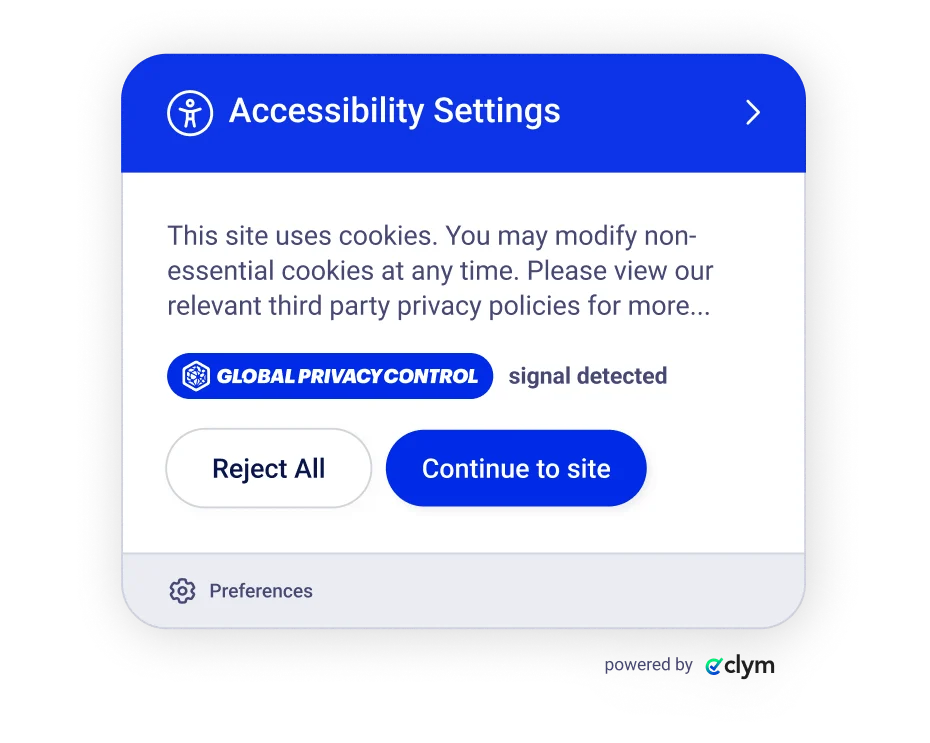
Visual confirmation to the user
Some privacy rules require a visible confirmation when a universal opt-out signal is detected. Messages such as:
The Global Privacy Control Signal Detected helps reinforce transparency and provides users with clarity about their active opt-out preference.
Pro tip: How to test your GPC implementation
You don't need to be a developer to verify if your site is handling the signal correctly. Here is a simple 3-step test:
1. Enable the Signal: Open a privacy-focused browser (like Brave or Firefox) or install a browser extension (like Privacy Badger or DuckDuckGo) that broadcasts the Global Privacy Control signal.
2. Visit Your Site: Navigate to your homepage as a new visitor (use Incognito/Private mode to ensure cached cookies don't interfere).
3. Check the Results: * Visual Check: Look for the notification "Global Privacy Control Signal Detected" on your consent banner.
* Settings Check: Open your privacy preference center. You should see that categories related to "Sale" or "Sharing" (like Marketing) are toggled OFF automatically.
If you see these indicators, your CMP is successfully intercepting the signal and suppressing tracking scripts before they fire.
The marketing impact and how GPC changes advertising
When Global Privacy Control signals are detected, analytics tools like Google Analytics may need to adjust how and when tracking scripts execute, which is explained in more detail in our guide on how Google Analytics should be configured under CCPA.
Reduced audience-building capabilities
Once selling or sharing is disabled, audience-based capabilities change significantly. Retargeting pools, behavioral segments, and lookalike audiences may exclude users who trigger GPC.
Lower match rates and slower platform learning
Advertising platforms rely on identifiers to optimize bids and build performance insights. When these identifiers are suppressed:
- match rates decrease,
- algorithmic learning slows,
- CPA may increase.
Conversion and attribution challenges
Marketing teams may see gaps in:
- multi-touch attribution paths,
- cross-device journeys,
- model-based reporting,
- and platform-reported conversions.
Without user-level identifiers, conversions may appear underreported even when campaigns perform effectively. These gaps often arise when platforms have limited data for honoring GPC signal requirements, which restrict the identifiers used for optimization.
Slower optimization cycles
Because platforms receive fewer signals, it may take longer to identify the best placements, audiences, or creative formats.
The analytics impact, data gaps, bias, and limited visibility
Lost or incomplete session data
Analytics scripts that depend on cookies or identifiers may not run, producing:
- missing sessions,
- reduced event capture,
- or aggregated-only reporting.
Skewed user behavior insights
Users who opt out may behave differently from those who consent. Without segmentation, funnels, retention metrics, and engagement data may become misleading.
Sampling bias increases
As more users fall under “opt-out” classification, datasets increasingly reflect only users who permit full tracking. This creates representational gaps in behavioral analysis.
Unreliable performance metrics
ROAS, conversion rates, and LTV calculations become harder to maintain. This is a growing challenge for teams trying to balance GPC and marketing attribution, as traditional multi-touch models depend heavily on the identifiers that GPC suppresses. Even small shifts in tracking availability can materially influence observed outcomes.
To explore how consent-aware measurement works in practice, the consent management solution page outlines how CMPs adapt analytics tools, support Google Consent Mode v2, and maintain privacy-first tracking configurations.
How many users might send the GPC signal and why that matters
GPC adoption is rising due to:
- privacy-focused browsers,
- privacy extensions,
- growing awareness of universal opt-out rights,
- and expanding state-level laws that recognize GPC.
Even if only 5–15% of site visitors trigger GPC, the impact on attribution, retargeting, and analytics can be substantial, especially on sites with a high number of Californian users.
Strategies for marketing and analytics teams to adapt to GPC
Build a first-party data foundation
Logged-in user behavior, CRM records, and consented identifiers provide stable, user-permissioned data that remains usable under opt-out scenarios.
Prioritize contextual advertising
Contextual methods do not rely on personal identifiers. They remain fully functional even when selling or sharing is disabled.
Leverage a consent management platform for tagging and global signaling
A Consent Management Platform (CMP) should automatically:
- Block incompatible scripts: Prevent non-consented tracking technologies from firing until the appropriate permissions are granted.
- Transmit downstream signals: Support the IAB Global Privacy Platform (GPP) standard to automatically propagate the GPC opt-out status to your advertising partners, helping to reduce data misalignment.
- Adjust tag behavior: Enable modeled measurement tools (such as Google Consent Mode v2) to maintain data visibility when users opt out.
- Maintain consistent logic: Apply jurisdiction-specific rules dynamically based on user location.
Clym’s RealtimeCompliance™ automates this process by identifying services, managing their behavior, and broadcasting the correct GPP signals without requiring manual configuration.
Adjust KPIs for a consent-driven world
Marketing teams should segment:
- consented vs. non-consented traffic,
- modeled conversions,
- revenue per consented user,
- and attribution differences.
This avoids misinterpreting incomplete datasets.
Foster collaboration between teams
Marketing, analytics, engineering, and privacy functions must coordinate closely to understand:
- which tools rely on personal data,
- how tags behave in opt-out conditions,
- and how reporting should adjust to these differences.
Common mistakes when handling GPC
Teams often run into avoidable issues when adapting their tracking and advertising workflows to universal opt-out signals. Common pitfalls include:
Allowing ad or analytics scripts to fire before GPC is processed, causing identifiers to be sent before the opt-out is applied.
Using outdated banners or theme-based tools that do not recognize GPC or cannot dynamically suppress incompatible scripts.
Failing to segment analytics data by consent state can lead to inaccurate funnel analysis, biased KPIs, and misleading performance conclusions.
Treating GPC as only a UX or design topic, rather than understanding its operational impact on tracking behavior, ad delivery, attribution, and modeled reporting.
If you would like help reviewing your tracking setup, you can book a demo to see how Clym identifies scripts and adapts tracking behavior based on user preferences and jurisdiction.
How a CMP should handle “global privacy control signal detected” for reliable marketing and analytics
A well-implemented CMP should be able to:
- detect GPC instantly,
- shift the user into an opt-out state,
- suppress or anonymize relevant tracking scripts,
- display clear visual acknowledgments,
- and apply consistent logic across every page.
Clym’s GPC integration is designed to automate these behaviors, offering an adaptive, low-effort approach to universal opt-out handling.
Preparing for a privacy-first marketing future
GPC reflects a broader move toward transparency and user autonomy. Marketing and analytics teams that embrace contextual experiences, first-party data, model-driven measurement, and consent-aware tools will be better positioned to maintain performance while respecting users’ privacy choices.
Conclusion
When a website displays “global privacy control signal detected,” it signifies that the visitor has opted out of selling or sharing personal information. While this reduces the availability of certain tracking signals, it also drives more responsible measurement practices and stronger first-party data strategies.
Solutions like CMPs, including those that detect and honor GPC automatically, help teams manage these transitions effectively without interrupting the user experience.
To learn how Clym supports GPC handling, script behavior adjustments, and jurisdiction-based consent models, visit our Consent Management Platform page.
FAQs
It means the user’s browser has sent a standard opt-out signal, which must be interpreted as a request not to sell or share personal information. When detected, the website must adjust tracking behavior automatically.
Yes. Under modern privacy laws, GPC is recognized as a universal opt-out mechanism that websites must honor when applicable.
These tools may be blocked, limited, or run in anonymized mode because the user cannot be included in selling or sharing-based targeting. This can reduce audience size and platform optimization signals.
Analytics tools may record fewer user identifiers or sessions, resulting in incomplete data and gaps in attribution. Some CMP setups support modeled measurement when identifiers cannot be used.
No. GPC applies specifically to selling and sharing activity, while a “Reject All” choice may disable additional categories such as analytics or personalization depending on the configuration.
Attribution models rely on identifiers that GPC suppresses, which can lead to underreported conversions or incomplete user journeys. Marketers may need to use modeled conversions or aggregated metrics.
Users who trigger GPC cannot be added to behavioral or cross-context profiles, removing them from retargeting pools and related audience expansion tools.
No. Essential cookies needed for the site to function can still operate. The restriction applies to selling, sharing, and certain tracking activities.
They can strengthen first-party data strategies, invest in contextual advertising, adjust KPIs, and adopt consent-aware tag management to maintain reliable reporting.
Yes. A CMP can recognize GPC signals, adjust script behavior in real time, and maintain a privacy-first user experience while keeping tracking workflows consistent across jurisdictions.

Adam is the Head of Digital Marketing at Clym, where he leverages his diverse expertise in marketing to support businesses with their compliance needs and drive awareness about data privacy and web accessibility. As one of the company’s original team members, Adam has been instrumental in shaping its journey from the very beginning. When he’s not diving into marketing strategies, Adam can be found cheering on his favorite sports teams or enjoying fishing.