Pseudonymization and GDPR explained
Pseudonymization replaces personal identifiers with codes to reduce risk. It stays under GDPR scope, differs from anonymization, and supports data protection obligations.
Pseudonymization replaces personal identifiers with codes to reduce risk. It stays under GDPR scope, differs from anonymization, and supports data protection obligations.
Pseudonymization is one of the GDPR’s recognized techniques for reducing privacy risk when working with personal data. It replaces direct identifiers with coded values, while keeping the information needed to re-identify someone separate and protected.
In this guide, we explain what pseudonymization means under GDPR, how it differs from anonymization, which techniques are commonly used, and how organizations can apply it as part of a broader data protection strategy.
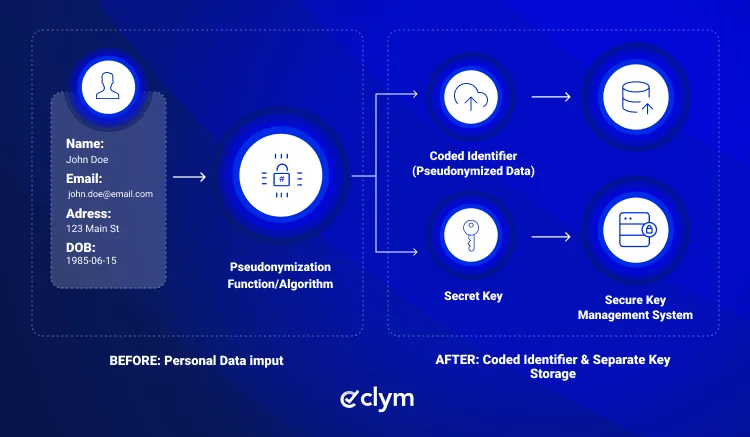
Pseudonymization is the process of replacing personal data with a coded identifier, so the data cannot be attributed to a specific individual without access to a separate decoding key. The key must be kept secure and apart from the pseudonymized data. Under GDPR Article 4(5), pseudonymization is an officially recognized data protection technique.
Think of it this way. Your name and email address in a database become "USER-4491". The database still holds your health history, purchase behaviour, or account activity, but without the matching key, nobody can tell that USER-4491 is you.
If a hacker steals the database, they get records without names. If an internal analyst reviews the data for research, they see patterns without private details. That is pseudonymization in practice.
The technique is especially valuable in contexts where data needs to flow between teams, systems, or research partners without exposing the identities of the people it relates to.
The GDPR references pseudonymization in several places, and the cumulative picture is clear: the regulation sees it as a responsible, proactive approach to data protection.
Here is how the key provisions stack up:
Article 4(5) defines pseudonymization as processing personal data so it can no longer be attributed to a specific data subject without additional information, where that additional information is kept separately and subject to technical and organisational measures.
Article 5(1)(f) (the integrity and confidentiality principle) requires that personal data be protected using appropriate technical and organisational measures. Pseudonymization is one such measure.
Recital 26 clarifies that pseudonymized data is still personal data because it can be re-linked to an individual. This means GDPR obligations do not disappear when you pseudonymize data.
Recital 28 explicitly encourages pseudonymization, noting that it can reduce risks to data subjects and help controllers and processors meet their data protection obligations.
The critical point: pseudonymization does not take data outside the GDPR’s scope. You still need a lawful basis for processing, you still need to respect data subject rights, and you still need to handle the data responsibly. What pseudonymization does is make your risk profile significantly lower and demonstrate that you are taking data protection seriously.
If you want to understand what rights data subjects retain over pseudonymized data, our guide on GDPR data subject rights and requests explains each right in detail.
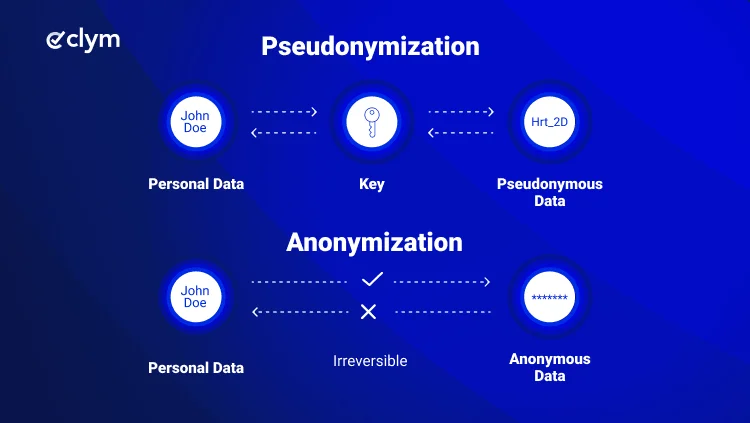
The most important distinction in data privacy techniques is often the most misunderstood one. Pseudonymization and anonymization are not the same thing, and confusing them can lead to incorrect GDPR assumptions.
The fundamental difference is reversibility. Pseudonymized data can be re-linked to an individual if someone possesses the decoding key. Anonymized data should not be reasonably linkable back to an individual, even when other available information is considered. Because of this, anonymized data falls entirely outside the GDPR's scope, while pseudonymized data remains firmly inside it.
Here is how they compare across the dimensions that matter most:
Pseudonymization | Anonymization | |
|---|---|---|
Definition | Replaces identifiers with codes that can be reversed with a key | Removes or alters data so no individual can ever be identified |
Reversible? | Yes, with the additional key | No, permanently irreversible |
Still personal data under GDPR? | Yes | No, falls outside GDPR scope |
Risk level | Reduced but not eliminated | Lower GDPR risk if anonymization is robust and irreversible |
Data utility | High: data can be re-linked for research or follow-up | Lower: cannot be linked back to individuals |
Typical use cases | Clinical trials, analytics, pseudonymous CRM profiles | Public data releases, statistics, and research publishing |
GDPR article | Article 4(5), Recital 28 | Recital 26 |
A practical example: a hospital running a clinical study can pseudonymize patient records, allowing researchers to analyse treatment outcomes without seeing patient names. If a specific patient needs to be contacted for follow-up, the hospital can use the decoding key to re-identify them.
Anonymization, by contrast, would make follow-up impossible. That is why pseudonymization is the preferred approach in healthcare research, where re-identification under controlled conditions is sometimes necessary.
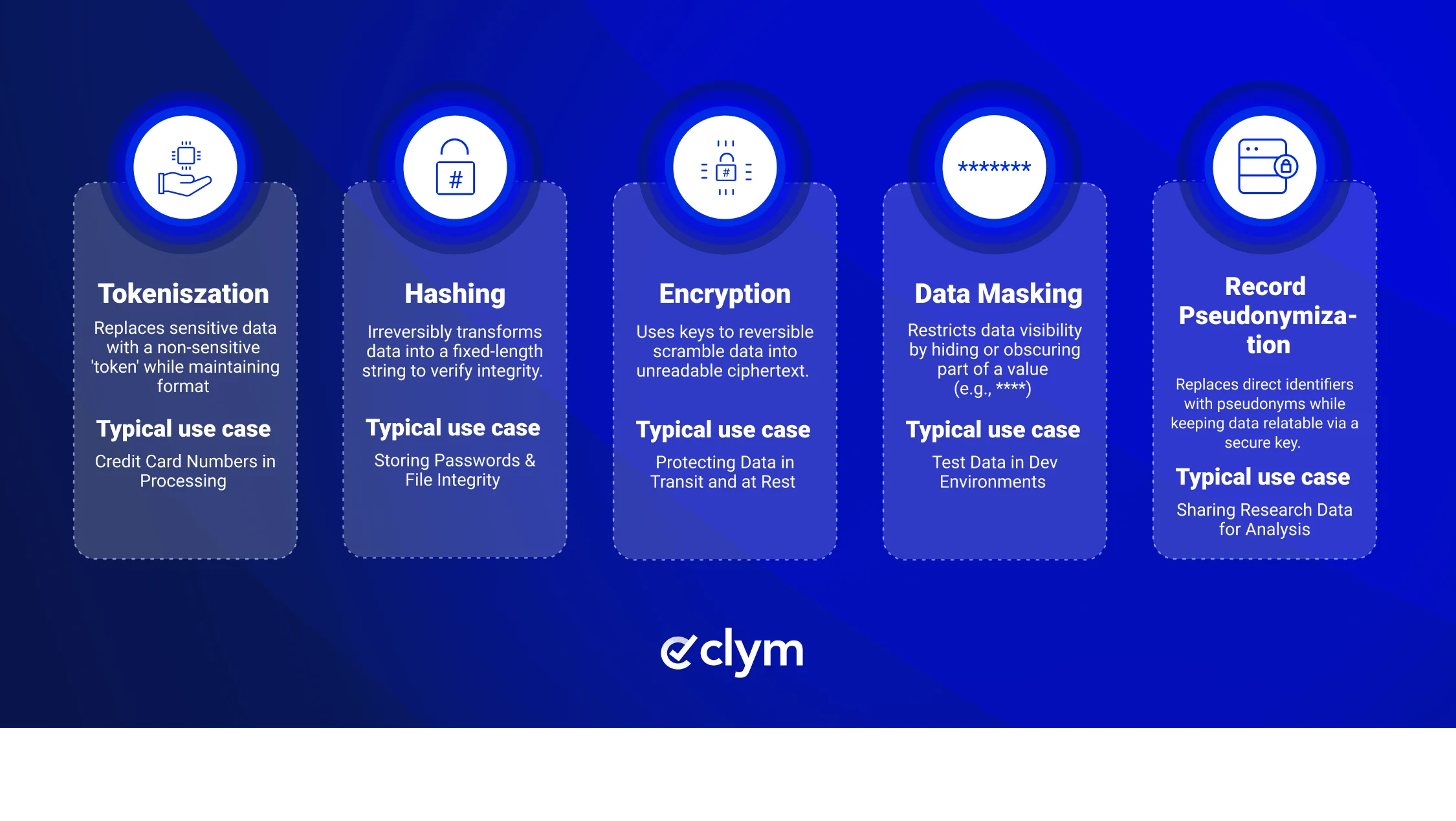
There is no single way to pseudonymize data. The right technique depends on your use case, the sensitivity of the data, and whether you need to recover the original values later. The European Union Agency for Cybersecurity (ENISA) has published detailed guidance on pseudonymization techniques and best practices. Here is a practical overview of the main approaches:
Technique | How it works | Best for |
|---|---|---|
Tokenization | Replaces data values with random tokens stored in a secure vault. The original value is only retrievable via the vault. | Payment data, healthcare records, marketing CRMs |
Hashing | Converts data into a fixed-length string using a hash function. One-way unless a salt is compromised. | Password storage, email list deduplication, audit logs |
Encryption | Encodes data with a key. The same key can decrypt it, so it is reversible under controlled conditions. | Data in transit, cloud storage, cross-border transfers |
Data masking | Replaces real values with realistic-looking fictional data (e.g., a real postcode replaced with a similar one). | Test and development environments, staff training data |
Record pseudonymization | Assigns each individual a unique identifier (e.g., User001) and stores the mapping separately and securely. | Clinical research, behavioural analytics, CRM profiling |
Most enterprise implementations combine more than one technique. For example, a marketing team might tokenize email addresses for analytics, hash passwords for authentication, and use record pseudonymization for CRM profiling, all within the same platform.
Implementing pseudonymization correctly requires more than just swapping names for codes. The GDPR sets a high bar for what counts as an effective technical and organisational measure. Here are the steps to follow:
Map your data. Identify which datasets contain personal data and which fields are direct identifiers (name, email, ID number) versus indirect ones (postcode, date of birth, behavioural data).
Choose your technique. Match the technique to the use case. If you need to recover original values, use tokenization or encryption. If you do not, hashing may be sufficient.
Separate and secure the decoding key. This is the most critical step. The key must be stored in a separate system with strict access controls. Anyone who can access both the pseudonymized data and the key can re-identify individuals.
Apply access controls. Limit access to both the pseudonymized data and the key on a need-to-know basis. Log all access attempts.
Update your records of processing activities. Document your pseudonymization approach in your Records of Processing Activities (RoPA). Note which datasets are pseudonymized, which technique is used, and where the key is held.
Review your Data Protection Impact Assessment (DPIA). If your processing is high-risk, pseudonymization is a measure you should document in your DPIA as a risk mitigation tool. It will not eliminate the need for a DPIA but it reduces the residual risk score.
Pseudonymization is not just a compliance checkbox. It delivers concrete operational and legal benefits:
If pseudonymized data is exfiltrated in a breach, the attacker cannot attribute any record to a specific individual without the decoding key. This significantly reduces the harm caused, and may lower your obligation to notify data subjects under GDPR Article 34, which only requires individual notification when a breach is "likely to result in a high risk" to those individuals.
Pseudonymization lets you share data with analytics partners, research institutions, or internal teams without exposing identities. This opens up legitimate data-driven activities that would otherwise carry too much risk or require broader consent.
Pseudonymization helps you use only the data you need for a given purpose. When an analyst running a performance report does not need to know who a customer is, pseudonymization enforces that boundary technically, rather than relying on process alone.
Supervisory authorities consider the security measures an organization had in place when assessing fines and enforcement action. Documented pseudonymization demonstrates a proactive, good-faith approach to data protection. It does not guarantee a particular regulatory outcome, but it is a meaningful factor in your favour.
Pseudonymized data can sometimes be retained for longer under the GDPR's storage limitation principle, particularly where it is used for archiving in the public interest, scientific or historical research, or statistical purposes (Article 89). The reduced privacy risk associated with pseudonymization is a factor that supervisory authorities consider when assessing whether extended retention is justified.
Pseudonymization is not theoretical. It is already embedded in how privacy-conscious organizations operate across industries:
Healthcare and clinical research: Patient records are pseudonymized before being shared with research teams, allowing studies on disease outcomes, drug efficacy, or population health without exposing individual identities.
Financial services: Transaction data used for fraud detection models or risk analytics is pseudonymized so that data science teams work with patterns, not personal financial histories.
Marketing and advertising: CRM data is pseudonymized before being passed to third-party analytics providers, supporting campaign measurement while reducing the data shared externally.
Software development and testing: Production databases are pseudonymized before being copied into development and test environments, preventing real customer data from appearing in non-production systems.
Human resources: Employee data used in internal analytics or benchmarking is pseudonymized, so reports on pay equity, performance, or attrition do not expose individuals.
Pseudonymization can reduce privacy risk, but it is only one part of a wider data privacy programme. Your team still needs a practical way to manage consent, respond to privacy requests, maintain privacy notices, and document how those workflows are handled.
Clym helps teams manage website consent, data subject requests, cookie and privacy policies, and jurisdiction-aware privacy workflows in one place.
Clym does not manage pseudonymization directly at the database level. That remains a technical implementation for your development or security team. Instead, Clym supports the operational privacy workflows that sit around technical safeguards.
Pseudonymization is one of the most practical tools in the GDPR's data protection toolkit. It reduces the risk attached to a breach, supports safer data sharing, and demonstrates that your organization takes privacy seriously. It does not remove you from the GDPR's scope, but it meaningfully reduces the consequences of getting things wrong.
The key things to remember: pseudonymized data is still personal data, the decoding key must be kept separate and secure, and the right technique depends on whether you ever need to recover the original values. If your organization handles personal data at scale, building pseudonymization into your processing by design rather than applying it reactively will put you in a much stronger position.
If you want to strengthen the rest of your data privacy programme alongside your technical measures, Clym can help you manage consent, data subject requests, and privacy policies in one place.
Under GDPR Article 4(5), pseudonymization is the processing of personal data so it can no longer be attributed to a specific data subject without additional information, where that additional information is kept separately and secured. It is a recognized technical data protection measure.
The GDPR does not make pseudonymization mandatory in all cases, but it actively encourages it. Recital 28 notes that pseudonymization can reduce risks to data subjects and help controllers meet their data protection obligations. It is often expected as part of appropriate technical and organisational measures under Article 32.
The key difference is reversibility. Pseudonymized data can be re-linked to an individual using a decoding key and remains personal data under GDPR. Anonymized data cannot be linked back to any individual by any means and falls outside the GDPR's scope. Most organizations use pseudonymization because true anonymization is very difficult to achieve and verify.
Yes. GDPR Recital 26 makes clear that pseudonymized personal data that could be attributed to a natural person by use of additional information is still personal data. All GDPR obligations, including lawful basis, data subject rights, and retention requirements, continue to apply.
The five main techniques are tokenization, hashing, encryption, data masking, and record pseudonymization. Each works differently and suits different use cases. Tokenization is ideal for payment and healthcare data. Hashing suits passwords and deduplication. Encryption is preferred for data in transit. Data masking works well for test environments. The right choice depends on whether you need to recover original values.
Documented pseudonymization can be a mitigating factor in enforcement. If breached data cannot be attributed to individuals because identifiers are pseudonymized and the key was not compromised, the harm to data subjects is lower. This may reduce the severity of the breach notification obligation and is considered by supervisory authorities when assessing proportionate responses.

Adam is the Head of Digital Marketing at Clym, where he leverages his diverse expertise in marketing to support businesses with their compliance needs and drive awareness about data privacy and web accessibility. As one of the company’s original team members, Adam has been instrumental in shaping its journey from the very beginning. When he’s not diving into marketing strategies, Adam can be found cheering on his favorite sports teams or enjoying fishing.