Clym Logo

What is a cookie consent management platform? (Complete guide for 2026)

~ 14 min read

Privacy enforcement is accelerating. In 2023 and 2024, regulators across Europe and the United States issued hundreds of millions of euros and dollars in fines, with cookie consent failures and missing opt-out mechanisms among the most commonly cited violations. In early 2025, the California Privacy Protection Agency issued its first formal enforcement action under the CPRA's expanded consent rules.

If your website sets analytics, advertising, or social media cookies, you have an obligation to manage consent correctly. A consent management platform (CMP) is the standard technical and legal solution. This guide explains what a CMP is, how it works, what regulations require one, and what to look for when choosing the right platform for your business in 2026.

What is a consent management platform (CMP)?

In short: A CMP automates what would otherwise require a legal team, a developer, and a compliance officer working in tandem, every time a user visits your website.

A consent management platform (CMP) is software that automates the collection, storage, and enforcement of user consent for cookies and data processing. The terms CMP, cookie consent management platform, and consent management software are used interchangeably across the industry.

In practice, a CMP does three things:

  • Displays a cookie consent banner informing visitors about data collection before any non-essential processing begins.

  • Records every consent decision, who consented, when, to which cookie categories, and from which location, creating a timestamped audit trail.

  • Enforces consent, blocking non-essential cookies and third-party scripts until the visitor actively opts in, and releasing them only after consent is given.

A full cookie consent management platform goes beyond a simple banner. It integrates with your tag management system, handles data subject requests (DSRs), runs a continuous cookie scanner to detect new trackers, and adapts the consent experience automatically based on each visitor's location and the applicable regulation.

How does a consent management platform work?

Here is the end-to-end flow from the moment a user arrives on your website:

  1. Cookie scanning: The CMP scans your website and detects all cookies and third-party scripts: Google Analytics, Meta Pixel, LinkedIn Insight Tag, YouTube embeds, chat widgets, and more. Platforms like Clym continuously monitor and classify 1,200+ third-party services in real time.

  2. Geolocation detection: The CMP identifies the visitor's location and determines which regulation applies. A visitor from Germany triggers GDPR rules; a California resident triggers CCPA/CPRA rules; a visitor from Brazil triggers LGPD rules.

  3. Banner display: The correct cookie consent banner is shown for the applicable regulation. GDPR requires opt-in consent before any non-essential data collection; CCPA requires an opt-out mechanism, and a Do Not Sell or Share My Personal Information link.

  4. Consent enforcement: Non-essential scripts are blocked until the user actively consents. Only after consent is given does the CMP release the relevant tags.

  5. Consent recording: Every decision is stored with a timestamp, consent ID, visitor location, categories accepted or rejected, and the version of the privacy policy in effect.

  6. Preference management: Users can revisit and change their consent preferences at any time, as required by GDPR and other opt-in frameworks. The CMP updates stored records accordingly.

  7. Regulatory updates: When laws change, the CMP automatically updates consent rules and banner logic, no manual intervention required to reflect the latest regulatory changes.


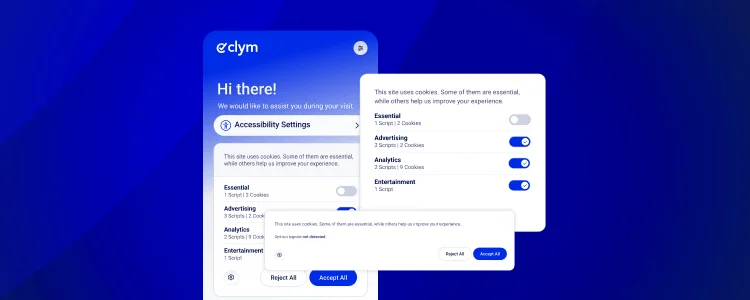
Consent Management Platform banner

Why do you need a cookie consent management platform?

The legal reality

Data privacy regulations now cover an estimated 75% of the world's population. The four most impactful privacy frameworks for most businesses are:

Regulation

Region

Consent model

Max penalty

European Union

Opt-in (prior consent required)

€20M or 4% of global annual turnover

California, USA

Opt-out (must honor Do Not Sell)

$7,500 per intentional violation

Brazil

Opt-in

2% of Brazil revenue, up to R$50M

EU (cookie law)

Opt-in for non-essential cookies

Varies by member state

Beyond GDPR and CCPA, more than 150 national and regional privacy laws are now in force, from PIPEDA in Canada, to PIPL in China, to POPIA in South Africa. Managing consent manually across all these jurisdictions is operationally impossible without a consent management platform.

Third-party cookies and scripts

Even if you believe your website does not collect data, it almost certainly does. Any page that loads Google Analytics, a Meta Pixel, a YouTube embedded video, a LinkedIn Insight Tag, or a customer service live chat widget is setting cookies on visitors' devices. Each of those third-party cookies requires consent under most privacy regulations. A consent management platform automatically detects and blocks these scripts until consent is obtained.

Google Consent Mode V2

Google Consent Mode is a framework that adjusts the behavior of Google tags (Analytics, Ads, Floodlight) based on the consent signals from your CMP. Without a CMP that supports Google Consent Mode v2, Google's advertising and measurement tools may operate in a non-compliant or degraded mode, affecting campaign performance and remarketing.

As of March 2024, Google requires Consent Mode v2 for all advertisers using audience-based features in the EEA. A compliant CMP handles this integration automatically.

Consent management platform and key regulations

GDPR consent management

Under GDPR, valid consent must be:

Requirement

What it means in practice

Freely given

No access to the website is conditional on accepting cookies

Specific

Separate consent for each purpose (analytics, advertising, etc.)

Informed

Clear explanation of what data is collected and why

Unambiguous

Affirmative opt-in action required; silence or pre-ticked boxes are not valid

Easy to revoke

Users must be able to withdraw consent as easily as they gave it

Documented

Every consent must be stored with a timestamp and an audit trail

A GDPR consent management platform handles all six requirements automatically, including consent receipts, audit logs, and preference management for end users.

CCPA consent management platform

The California Consumer Privacy Act (CCPA), as amended by the CPRA, takes a different approach from GDPR: it assumes opt-in but gives consumers the right to opt out of the sale or sharing of personal information. A CCPA-compliant CMP must display a 'Do Not Sell or Share My Personal Information' link on every page, process opt-out requests within 15 business days, honor Global Privacy Control (GPC) signals automatically, and record consumer choices for at least 12 months.

A consent management platform offering a CCPA solution must handle both GDPR opt-in and CCPA opt-out logic simultaneously for websites with international audiences.

IAB consent management platform (TCF 2.3)

The IAB Europe's Transparency & Consent Framework (TCF) is the industry standard for digital advertising consent in Europe. An IAB consent management platform implements TCF 2.3, enabling publishers to pass structured consent signals to ad tech vendors in the IAB's Global Vendor List.

If your website monetizes through programmatic advertising, choosing a CMP registered with the IAB TCF is essential. Clym supports IAB TCF 2.3, facilitating proper consent signals to all downstream advertising partners.

Consent frameworks built into one consent management platform

Cookie consent is just one of several consent frameworks a modern CMP needs to handle in 2026. Regulations and industry standards now require businesses to manage multiple distinct consent types across different legal contexts, all from a single platform. Here is what that looks like in practice.

Consent framework

What it covers and why it matters in 2026

Manages cookie consent by informing visitors, collecting opt-in or opt-out choices, blocking non-essential scripts, and recording consent decisions under GDPR, ePrivacy, CCPA, LGPD, and other privacy laws.

HIPAA authorization support helps healthcare websites collect explicit patient consent before using or sharing protected health information (PHI), while recording decisions and blocking third-party scripts before authorization is given.

The Video Privacy Protection Act (VPPA) requires affirmative consent before sharing personally identifiable video viewing data with third parties, especially for websites using embedded videos, streaming content, or behavioral tracking.

Wiretapping consent supports notice and consent before activating tools that may monitor or record communications, such as live chat, especially in two-party consent states like California.

IAB TCF 2.3 passes structured consent signals to advertising vendors for programmatic advertising, helping publishers manage vendor consent and ad delivery in the EEA.

Google requires Consent Mode V2 for advertisers using audience features in the EEA, allowing Google tags to adjust analytics, ads, and remarketing based on user consent choices.

Microsoft Consent Mode sends consent signals to Microsoft’s UET tag so Microsoft Ads tracking and conversion measurement adjust based on user preferences in consent-regulated markets.

Global Privacy Controls (GPC) are browser-level opt-out signals that a CMP can detect and apply before tracking scripts load, including under CCPA opt-out requirements.

The Global Privacy Platform (GPP) standardizes consent and opt-out signals across privacy laws and jurisdictions, including US state privacy laws and international frameworks.

Clym's consent management platform supports all nine of these frameworks from a single integration. Businesses do not need separate tools for HIPAA authorization, wiretapping consent, IAB TCF, or GPC; each framework is handled by the same widget and recorded in the same audit trail.

Consent Management banner

What to look for in a consent management platform

Core features

Feature

Why it matters

Cookie scanner

Detects all cookies and scripts on your website, including newly added ones

Geolocation and geofencing

Serves the correct consent banner based on visitor location

Multi-regulation support

Covers GDPR, CCPA, LGPD, and 150+ other laws from one platform

Audit trail

Stores timestamped consent records for regulatory review

Google Consent Mode v2

Required for Google Ads and Analytics in the EEA

IAB TCF 2.3

Required for programmatic advertising in Europe

DSR management

Handles access, deletion, portability, and correction requests

Auto-blocking

Blocks non-essential cookies before consent is given

Customizable banner

Match the widget to your brand without coding

Mobile-responsive

Compliant experience across all device types

Platform compatibility

A good consent management platform integrates with your existing stack with minimal effort. Look for native support for:

  • CMS platforms: WordPress, Shopify, Wix, BigCommerce, Magento, Webflow

  • Mobile: iOS and Android web applications

  • Custom websites: via JavaScript snippet or DNS-level integration

Clym deploys via a single JavaScript snippet in under 30 minutes and works across any website or CMS, including WordPress, Shopify, Wix, and custom-built websites, as well as mobile web applications.

Accessibility (WCAG compliance)

A cookie consent banner that covers page content, traps keyboard navigation, or is unreadable for screen-reader users creates both an accessibility violation and a poor user experience. A WCAG consent management platform meets WCAG 2.1 AA standards, supporting compliance with ADA, Section 508, and the European Accessibility Act (EAA). Google also factors page experience and accessibility into rankings, so a poorly implemented banner can affect both compliance and SEO.

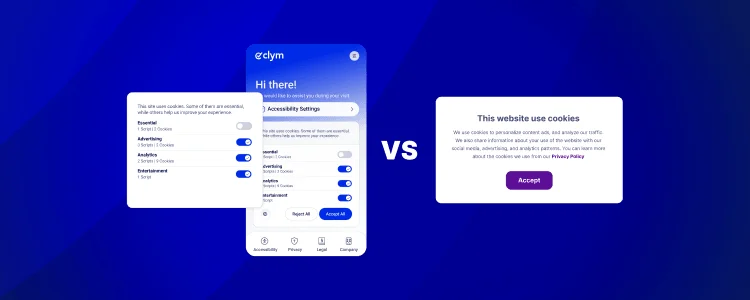
Clym Consent Management Platform vs Cookie banner

Consent management platform vs cookie consent tool: what's the difference?

Feature

Consent management platform

Cookie consent tool

Cookie banner display

Consent management platform

Yes

Multi-regulation support

Yes

Limited (1-2 laws)

Geolocation-based rules

150+ regulations

Sometimes

Audit trail and consent records

Yes

Rarely

DSR management

Yes

No

Google Consent Mode v2

Yes

Sometimes

IAB TCF 2.3

Yes

Rarely

Real-time cookie scanner

Yes

Rarely

API and tag management integration

Yes

Rarely

Accessibility compliance (WCAG)

Yes

Rarely

A cookie consent tool handles the banner. A consent management platform handles the entire consent lifecycle, from detection and disclosure to enforcement, recording, and user rights management.

Consent management platform categories

Enterprise consent management platform

Enterprise CMPs are designed for organizations managing multiple domains, high traffic volumes, and complex regulatory environments. Key requirements include:

  • Multi-domain and multi-brand management from a single dashboard

  • Volume-based pricing (per domain or per pageview)

  • Dedicated account management and SLA commitments

  • API access for integration with DMP, CRM, and tag management systems

  • White-label options for agencies and MSPs

Clym's Enterprise tier scales from high-volume single websites to organizations managing 1,000+ domains, with dedicated support and custom SLAs.

Free consent management platform

Free consent management platforms exist, but typically offer limited functionality: covering one or two regulations, offering minimal customization, and providing no audit trail, support for consent frameworks, or DSR management. For small websites with minimal traffic and limited international reach, a free CMP may be sufficient.

For businesses serving EU or California users at any meaningful scale, the compliance gaps in a free tool typically outweigh the cost savings.

Open source consent management platform

An open source consent management platform gives developers full control over the consent implementation, but requires significant ongoing maintenance to stay current with regulatory changes. For most businesses, the compliance overhead of maintaining an open source CMP outweighs the cost of a managed solution.

Consent management platform pricing

CMP pricing typically follows one of three models:

  • Per domain / per month: A fixed rate per domain, common for SMB and mid-market plans. Simple to budget and easy to scale as you add domains.
  • Per pageview: Scales with traffic volume; common for high-traffic publishers where usage varies significantly month to month.
  • Volume partner pricing: For agencies and MSPs managing many client domains, per-domain rates decrease as the number of domains under management grows.

When evaluating consent management platform pricing, factor in the total cost of coverage. A platform covering 150+ regulations at a fixed rate delivers far better value than one requiring add-ons for each jurisdiction.

Clym's governance portal and consent management platform

Consent and preference management platform

The next evolution in consent management is the consent and preference management platform, a broader framework that goes beyond cookies to manage user preferences across all channels and touchpoints: email marketing, ad targeting, and data sharing.

In a consent and preference management model, users have a centralized preference center where they can control not just cookie consent but all their communication and data-sharing preferences with a brand. This is increasingly relevant as regulations expand beyond web cookies to all forms of personal data processing.

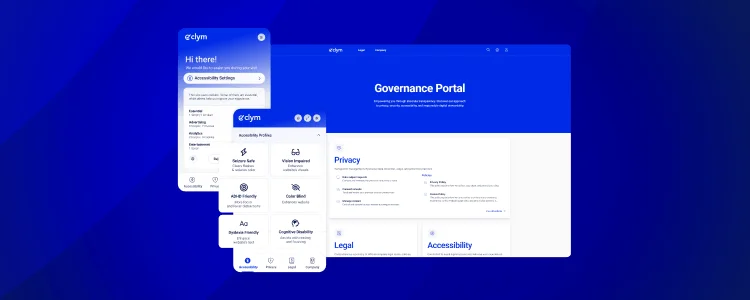
Clym's Governance Portal takes this further. Hosted on a brand's own subdomain, it gives users a dedicated compliance hub where they can manage consent receipts, track the status of any Data Subject Requests they have submitted, submit whistleblowing cases, raise vulnerability disclosure (bounty hunting) requests, and file content takedown requests, all alongside access to the brand's relevant legal documents in one place, forming the foundation of a full consent and preference management experience.

Does a cookie consent banner affect SEO?

This is a common concern, and the answer is nuanced. A properly implemented CMP does not negatively affect SEO. However, a poorly implemented one can:

  • Slow page load speed: Page speed is a direct ranking factor. A lightweight CMP with asynchronous loading has a negligible performance impact.

  • Block Googlebot: If your CMP blocks Google's crawler from accessing content, your pages may not be indexed correctly.

  • Create accessibility issues: A banner that covers content or disrupts navigation signals a poor page experience, which Google uses as a ranking input.

  • Trigger Core Web Vitals issues: A CMP that causes layout shifts (poor CLS) or delays interactivity (poor INP) will affect your Core Web Vitals scores.

Clym's cookie banner loads asynchronously, requires no separate installation for accessibility features, and delivers a seamless experience across all devices, minimizing any SEO impact while supporting your compliance effort.

Conclusion

A consent management platform is no longer optional for businesses operating online. With hundreds of data privacy regulations in force globally and enforcement growing, the question is not whether you need a CMP, but which one is right for your scale, technology stack, and regulatory exposure.

Key takeaways:

  • A CMP automates cookie consent collection, enforcement, and documentation across all applicable regulations

  • GDPR requires opt-in consent; CCPA requires opt-out; both require documented audit trails

  • Google Consent Mode v2 and IAB TCF 2.3 support are essential for digital advertising compliance

  • Look for real-time cookie scanning, geolocation-based rule application, DSR management, and WCAG accessibility compliance

  • Modern CMPs like Clym deploy in 30 minutes via a single code snippet, covering WordPress, Shopify, Wix, and custom websites

  • Pricing ranges from free (limited) to enterprise-scale volume pricing for agencies managing thousands of domains

Frequently asked questions

CMP stands for consent management platform, a software that automates the collection, storage, and management of user consent for cookies and data processing.

No regulation mandates a CMP by name, but the legal requirements of GDPR, CCPA, and similar laws are effectively impossible to satisfy at scale without one. GDPR requires documented, revocable, granular consent and audit trails for every consent decision. A CMP is the standard technical mechanism for meeting these obligations.

A cookie banner is one component of a consent management platform; it is the visible notice shown to users. A full CMP also includes a cookie scanner, consent database, audit trail, user preference management, DSR handling, and integrations with Google Consent Mode and IAB TCF.

With a modern CMP like Clym, deployment takes as little as 30 minutes via a single JavaScript snippet. No developer resources are required for standard implementations. Enterprise deployments with custom integrations typically complete within a few days.

Google Consent Mode is a framework that allows your CMP to communicate user consent status to Google's tags. When a user declines analytics or advertising cookies, Google Consent Mode tells Google Analytics and Google Ads to operate in a privacy-safe mode, using modeled data rather than actual tracking, so campaign measurement continues without violating consent.

The IAB Transparency & Consent Framework (TCF) is the ad industry's standard for communicating consent to programmatic advertising vendors. An IAB consent management platform registered with TCF 2.3 facilitates properly structured consent signals to ad tech vendors in the IAB's Global Vendor List, a requirement for compliant programmatic advertising in Europe.

Free CMPs are available and appropriate for very small websites with limited international traffic. However, they typically lack audit trails, multi-regulation support, DSR management, and Google Consent Mode integration. Businesses serving EU or California users should evaluate whether a free tool satisfies the full legal standard.

Adam Safar

Head of Digital Marketing

Adam is the Head of Digital Marketing at Clym, where he leverages his diverse expertise in marketing to support businesses with their compliance needs and drive awareness about data privacy and web accessibility. As one of the company’s original team members, Adam has been instrumental in shaping its journey from the very beginning. When he’s not diving into marketing strategies, Adam can be found cheering on his favorite sports teams or enjoying fishing.

Find out more about Adam